
As an attempt to re-ingratiate myself to the spirit of design, I’ve decided to put my preferences to writing à la Arne’s page of the same name on androidarts.com. The following is a non-exhaustive list of some of the stuff I like in some of the games I like.
These are personal preferences. Yes, I do watch the battle ability cutscenes in the Disgaea games without skipping them every single time. I can’t be considered a paragon of sensibility, but I like what I like.
–
• Eclectic, Intricate Itemization
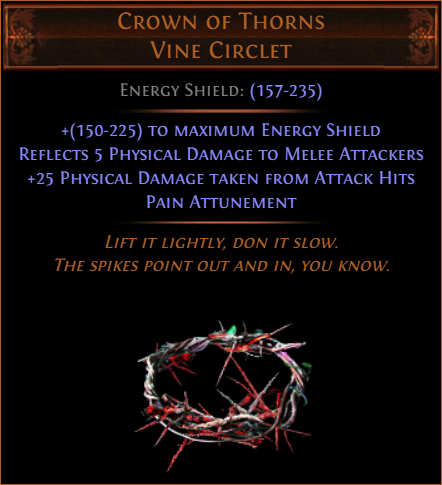
I like items with variety and variation. Diablo II and Path of Exile do this well. There is something compelling about a set of standalone and disparate items that are as they are (take Zelda 1, for example), but true flavor gushes out when there are a dozen variations of one item alone. When mixed with an eclectic pool of base items, those variations twist out and into other aspects of the game: equipment, location, battle, and make the whole delicious.
This item is real, because you found it there, it is that, it’s like this, you wanted to keep it, and now you have it. It is real.
I could write much more about this, but for now I’ll just say that anything that looks to Magic: The Gathering for itemization reference is looking the right way, despite it not having any of this kind of thing in the first place. Captivity breeds creativity, they say.
• Staggered Complexity
“You can use that like that!?” is one of the most exciting things someone can say while playing a game.
The key here, I think, is to introduce a very simple rule and then introduce something that is affected by the rule in an unexpected way. In The Binding of Isaac, the rule is that bombs blow up. You understand right away that bombs can hurt enemies. Then, you understand that they can hurt you. Then you find that they can destroy rocks.
Later, you blow up a wall and accidentally open a secret room.
From your perspective, the game’s complexity and depth kept increasing despite the rules remaining unchanged. You feel like you’ve discovered something, and the game feels more alive.
New rules that sit on top of old rules are also fun. For example, an RPG with equip-able items that grant various bonuses introduces an item that grants a massive bonus that diminishes for each other item equipped. Now the player’s decision-making has a layer of esotericism to it that wasn’t there before; something fun to contemplate.

• Consumable Materials
Notice that I haven’t written “crafting”. There is some difficult-to-capture distinction between a boring system that feels like a waste of time and a lovely system that makes you want to engage with it. Elden Ring deals with materials poorly, both sitting between permanence and impermanence in a totally unsatisfying way and having much too many materials compared to how restrictive the recipes are. I’m not interested in crafting systems where, extrapolated, nothing is required on the part of the player but time.
I’d like to see more systems where the individual materials that make up greater recipes have their own use. If something is purely material, it’s a little boring unless it’s exceedingly rare or hard to acquire, doubly so if it’s only needed for one or two recipes. At that point, it feels more like a time-delayed choice on the part of the player rather than something “real”.
Additionally, recipe systems with semi-deterministic semirandom outcomes are just pure fun.
• Tradeoffs and Trash Items
A weapon that quadruples your damage but halves your attack speed is more interesting than a weapon that doubles your damage alone. There is no “but”, here. Rather than a personal preference, I believe this is truth. A weapon that halves your damage and does nothing else is also interesting. No, it’s not “good”, but that it’s in the game at all is good.
I don’t think this is something that someone can be made to understand by words alone. If you disagree, something is wrong with you. And if something is wrong with you, why are you here? Oh. Got you. Got your nose.
Anyway, if it were up to me I might have had Gwynevere give you the Straight Sword Hilt. (Note: After writing this, I found out about the Artorias sword thing. That complicates the whole idea, so please forget you knew anything about it, either.)
• Uncertainty
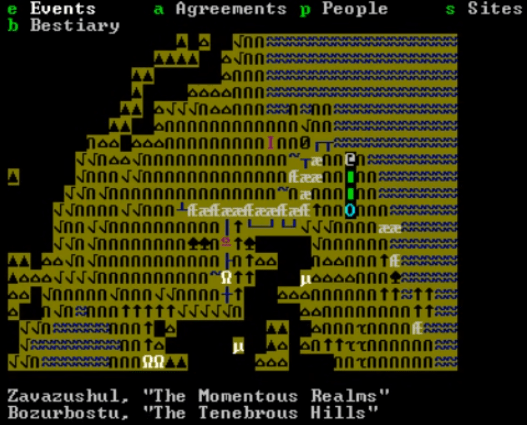
Uncertainty on the part of the game is a useful spice. Where does this door lead? When the game itself doesn’t know, then there’s no possible way for the player to know. Suddenly, it’s engaging. This kind of thing is most commonly seen in random enemy encounters or random item drop chance.
“Procedural” is an important word, but it’s just one part.
The greatest design mistake isn’t to introduce too much uncertainty, but to introduce uncertainty in a way that flattens everything out. It’s fun to have both intense spikes of chance and also to have guided randomness that feels more subliminal than concrete.
• Cold Sweat
For lack of a better term. Dialogue options and other types of narrative player choice often have no important mechanical heft because the player doesn’t know what they don’t know, and this lack of knowledge usually isn’t leveraged well. As an aside, visual novels are generally able to dodge this lack of heft because the genre is known for multiple chunks of narrative. However, design-wise, even visual novels have issues related to “not knowing what’s missing”.
While playing an RPG, if I select a dialogue option that locks out a whole sequence of encounters, and I don’t expect it to do that and afterwards don’t know that it has done that, it hasn’t. My experience is unaffected. I might as well have just been playing a version of the game without those encounters in the first place.
You have to let players feel it. Everyone who plays Dark Souls white-knuckle grips their controller when YES/NO appears on the screen; even if you don’t know what the outcome will be, you feel that there must be an outcome. After all, the last time you chose YES you found someone dead.
Multiple dialogue options that result in the same lines of text are a design faux pas and offenders should have their tongues and hands removed.
–
I’ve left out a few things that are more directly related to story or overly vague concepts that are too difficult to succinctly put into words.
See you next time.
– ANWN M.
